
A practical guide from Packaging in Time to help you choose better materials, structure, printing, and finishing for custom boxes.
CUSTOM PACKAGING GUIDE
Custom Gift Boxes
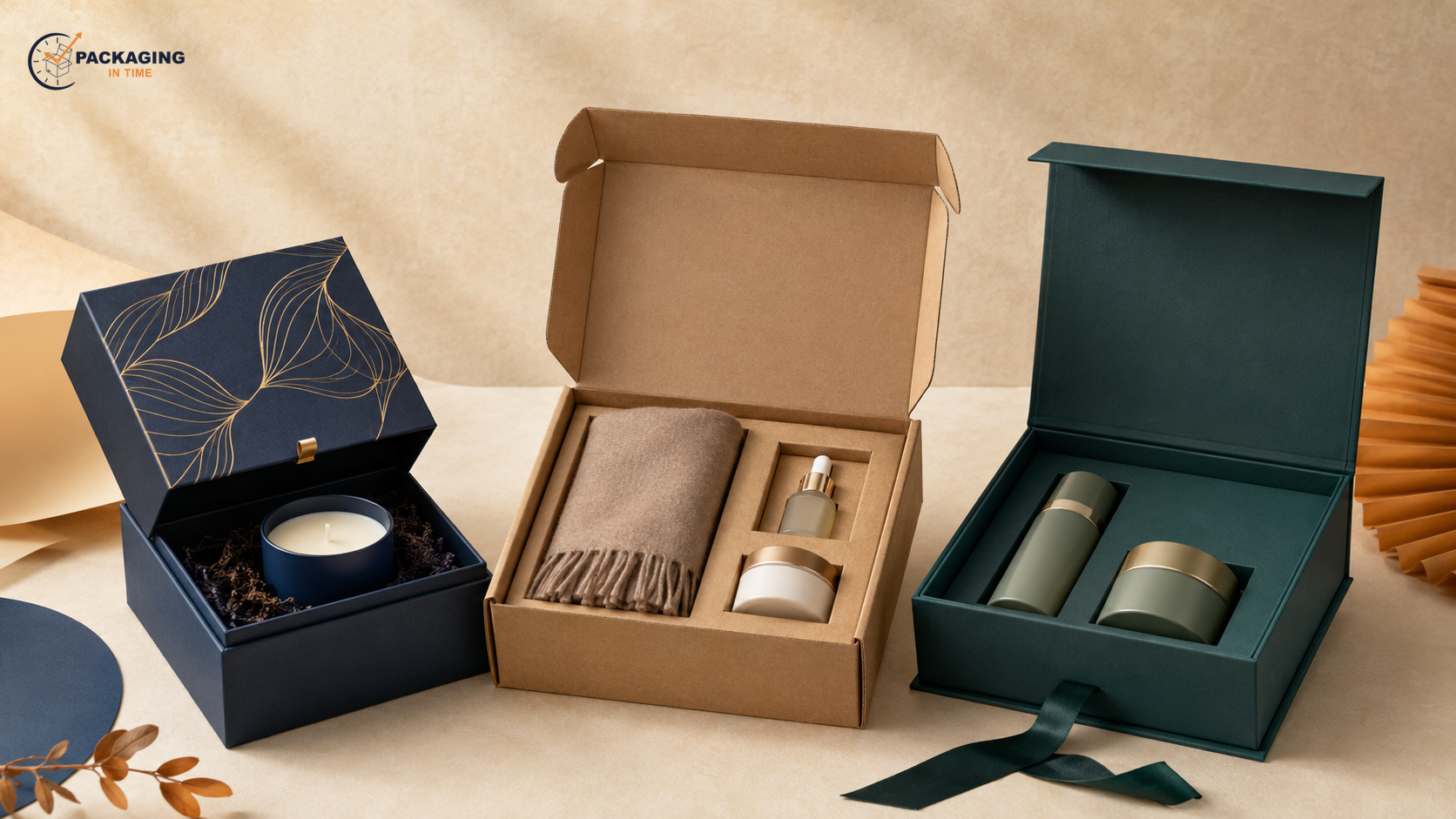
Rigid, magnetic, and printed gift packaging
SEO Meta Title: Custom Gift Boxes | Rigid, Magnetic, and Printed Gift Packaging
Recommended URL Slug: custom-gift-boxes
SEO Meta Description: Custom gift boxes for retail, corporate gifting, and product launches. Choose rigid or folding structures, magnetic closures, inserts, printing, and finishes.
Custom Gift Boxes: Rigid, Magnetic, and Printed Gift Packaging
Many gift boxes look similar before they are packed. Their differences appear at the handoff: a lid that lifts too easily, a product that shifts, a dark finish that scuffs, or a customer-facing box that arrives damaged inside a parcel shipment. The structure, insert, surface treatment, and outer shipper need to work as one system.
Packaging in Time produces custom printed packaging for products that need a considered presentation. For gift programs, the practical work begins with the product, its packed arrangement, and the route to the customer. Then the team can select a folding carton, rigid set-up box, lid-and-base box, magnetic closure, sleeve, insert, print process, and delivery protection that suit the job.
What Are Custom Gift Boxes?
Custom gift boxes are branded boxes made to a defined product size, structure, material, artwork layout, and packing method. They are used for retail gifts, corporate kits, product launches, seasonal assortments, subscription offers, and direct-to-consumer orders. A gift box can help present the product, hold components in a set order, carry brand artwork, and make opening easier. It does not automatically provide the protection needed for parcel shipment.
Gift Box, Retail Carton, and Shipping Box
A gift box is normally the package a customer sees and keeps. It may be a rigid set-up box, a folding carton, a sleeve around a tray, or a two-piece lid-and-base structure. The product may sit directly inside it, or it may be held by tissue, a paperboard insert, molded pulp, a divider, or a separate inner pack.
The shipping box is a different layer. It is commonly a corrugated mailer or outer case that manages impacts, compression, void space, labels, and carrier handling. One structure can sometimes fill both roles for a low-risk product, but a premium presentation box usually needs a separate corrugated shipper. Custom packaging boxes can be specified across these layers rather than treated as one generic box.
What a Gift Box Must Do
Start with the jobs the package must perform. A counter gift box may prioritize presentation, stacking, and a clean opening. A corporate kit may need several items positioned in a sequence. A luxury candle or glassware set may need edge protection and a stable insert. An apparel box may need enough depth for a folded garment without creating empty space. A direct-to-consumer program may need each of those functions plus a reliable outer shipper.
Define the product weight, fragility, count, arrangement, customer opening direction, display channel, and shipping route before selecting the visual treatment. This prevents a common mistake: approving a box style because it photographs well, then changing the structure after the product does not fit or the package cannot survive fulfillment.
Which Custom Gift Box Style Fits Your Product?
Quick structure match
Gift-box requirement | Typical structure | Confirm before production |
|---|---|---|
Premium reusable presentation | Rigid set-up, lid and base, or shoulder and neck | Product mass, lid fit, wrapped finish, insert, outer shipper |
Fast packing and flat storage | Folding carton with tuck or lock closure | Base lock, board stiffness, assembly method, packed weight |
Tidy reveal and branded outer shell | Tray and sleeve | Sleeve friction, tray dimensions, scuff exposure, insert height |
Hinged premium closure | Magnetic rigid box | Flap alignment, magnet placement, hinge behavior, shipper protection |
Multi-item kit or fragile set | Gift box with fitted insert plus corrugated shipper | Product geometry, insert retention, drop and vibration conditions |
The best gift-box style is determined by product weight, product geometry, opening experience, assembly method, and channel. A rigid box can make sense for a premium reusable package. A folding carton can make more sense where flat shipment, storage efficiency, and quick assembly matter. The same product can use either structure, but the tradeoffs are not the same.
Rigid Set-Up Gift Boxes
Rigid set-up boxes are built from thicker board and typically supplied in their formed shape. They are often selected for premium retail, jewelry, cosmetics, candles, technology accessories, and corporate gifts because they feel substantial in the hand and create a stable platform for inserts and wrapped finishes.
Rigid construction does not mean indestructible. The wrapped surface can scuff, corners can crush, and a large lid can flex if the board system, wrap, and product mass are poorly matched. It also takes more volume in storage and shipping than a flat folding carton. Review the board, wrap, lid fit, insert, and delivery case together.
Folding Gift Boxes
Folding gift boxes are die-cut and scored paperboard structures that can ship flat before packing. They can use tuck, lock, or assembled-base closures and suit apparel, smaller accessories, food gifts with an appropriate inner pack, promotional kits, and retail products that do not need the weight or cost of a rigid box.
Their main advantage is operational. Flat cartons use less warehouse space before assembly. However, a folding box needs the correct score pattern, board stiffness, and closure design for the product's weight and handling. A folding structure with a weak base or too much empty space can look less controlled than a properly specified rigid box.
Two-Piece Lid-and-Base and Shoulder-and-Neck Boxes
Two-piece gift boxes use a separate lid and base. The lid may cover the base fully, partially, or meet a raised shoulder-and-neck section. This structure works well where a slow, deliberate opening is part of the product reveal. It is also useful for products that need a removable lid rather than a hinged opening.
Lid fit should be confirmed with a physical sample. A lid that is too tight can tear a wrapped surface or frustrate the customer. A loose lid can separate during handling. The depth of the lid, base, and shoulder changes both the opening feel and the amount of support around the packed product.
Magnetic Closure Gift Boxes
Magnetic closure boxes normally use a hinged lid with embedded magnets in the flap and front panel. They can create a tidy close and work well for apparel, gifts, technology accessories, and corporate kits. The magnet is only one component in a larger construction. Hinge behavior, wrapped board, adhesive, product weight, insert profile, and shipping protection still need review.
Do not use a magnetic closure as a reason to omit outer delivery protection. The closure can keep a retail box closed during normal handling, but a parcel system still needs to control drop, vibration, crushing, and rubbing against the customer-facing surface.
Tray-and-Sleeve Gift Boxes
A tray-and-sleeve format uses a sliding sleeve around an inner tray. It can place branding on the sleeve while the tray holds the product and insert. This separation can be useful for cosmetics, small electronics, food gifts with a suitable primary pack, and seasonal sets.
The sleeve must have enough friction to stay in place without becoming difficult to remove. Measure the finished tray, wrap thickness, insert height, and product profile. A sleeve can also become a scuff point during repeated handling, especially with high-coverage dark printing or a soft surface finish.
How Do You Size a Custom Gift Box?
Sizing is not simply adding a little space around the product. The design must account for the product's complete packed state, internal components, board thickness, insert compression, loading method, and removal clearance.
Measure the Product and the Packed Arrangement
Start with internal dimensions: length, width, and depth. Measure the product at its widest, deepest, and tallest points after all normal components are present. Include caps, pumps, cords, handles, labels, protective bags, folded garments, and anything that changes the final footprint.
For a kit, measure the packed arrangement rather than each item alone. The arrangement may be a row, a stack, a tray, or a tiered insert. Record the heaviest variation, not only the best-looking sample. If a campaign includes several product sizes, decide whether one adjustable insert can support them or whether each variation needs its own packout.
Set Clearance and Insert Tolerances
The product needs enough clearance for packing and removal. It should not have enough unused space to slide against the box walls. An insert can manage this better than simply increasing the box size. Paperboard inserts, molded pulp, formed trays, dividers, pads, and tissue all serve different purposes.
Clearance must include the material itself. A wrapped rigid box loses internal space to board and wrap. A molded insert occupies space and may compress slightly. A product bag or tissue wrap adds thickness. The final dieline and insert drawing should state which dimensions are internal, which are external, and which belong to the product or component.
Which Materials and Inserts Work in Custom Gift Boxes?
Material choice affects the way the box prints, folds, feels, protects, stores, and moves through a recovery system. Paperboard, rigid board, and corrugated board are related fiber-based materials, but they are not interchangeable structures.
Paperboard, Kraft, Rigid Board, and Corrugated Protection
Folding cartons use paperboard. Smooth white board can provide a clean surface for detailed print, while kraft board gives a natural brown appearance and has different print behavior. The final choice should account for the print coverage, expected handling, closure type, and internal product mass.
Rigid boxes use thicker board that is often wrapped with printed or colored paper. The construction provides shape and a higher-end feel, but the wrapped surface needs protection from handling and transport. Corrugated board uses linerboard and a fluted medium. It is commonly used for mailers, outer shippers, master cases, and some durable gift structures. For a deeper style comparison, see Custom Product Boxes: Types, Sizes, and Printing Options.
Tissue, Paperboard Inserts, Molded Pulp, and Dividers
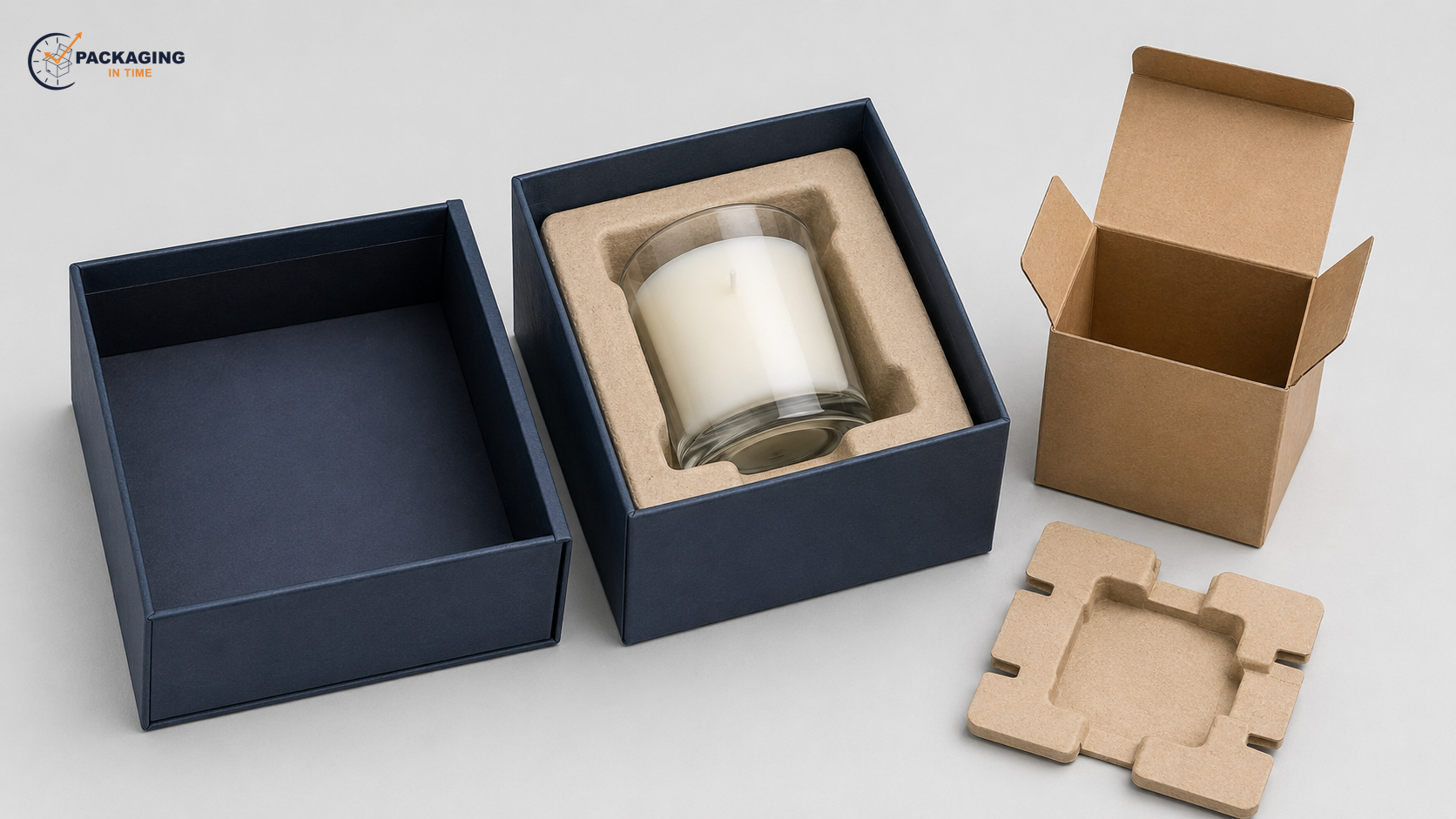
Tissue can soften the opening and reduce light surface contact. It is not a substitute for an insert where the product must be restrained. Paperboard inserts work well for lightweight items and organized kits. Dividers separate products and can reduce contact between fragile components. Molded pulp can provide a shaped cradle for selected products. Foam or thermoformed components may be appropriate for specific products, but their material, end-of-life path, and fit should be reviewed as separate choices.
The insert should support the product without damaging it. A candle jar needs a different contact pattern than a silk scarf. A glass bottle needs different support than a boxed accessory. Test how quickly staff can load the product, how the customer removes it, and whether the insert stays in place after the lid is opened.
How Should You Print and Finish a Gift Box?
Printing turns a practical box into a branded presentation. It must still work around folds, glue areas, closures, barcode zones, and surfaces that will be handled repeatedly.
Color, Artwork, and Dieline Controls
CMYK process printing is used for multicolor artwork. Spot colors are separately specified inks used where a controlled color is needed. White ink can be used on selected darker or kraft substrates. None of these approaches guarantees an exact appearance without approval of the substrate, print method, proof, and viewing conditions.
The dieline is the manufacturing map. It identifies cut lines, folds, scores, glue areas, safe zones, bleed, apertures, and structural panels. Keep essential artwork away from folds, corners, lid edges, magnets, and glue flaps. Keep codes away from distortion and quiet-zone interference. A final approved artwork file needs a version identifier, proof status, and named sign-off owner before production.
Foil, Embossing, Debossing, Spot UV, and Coatings
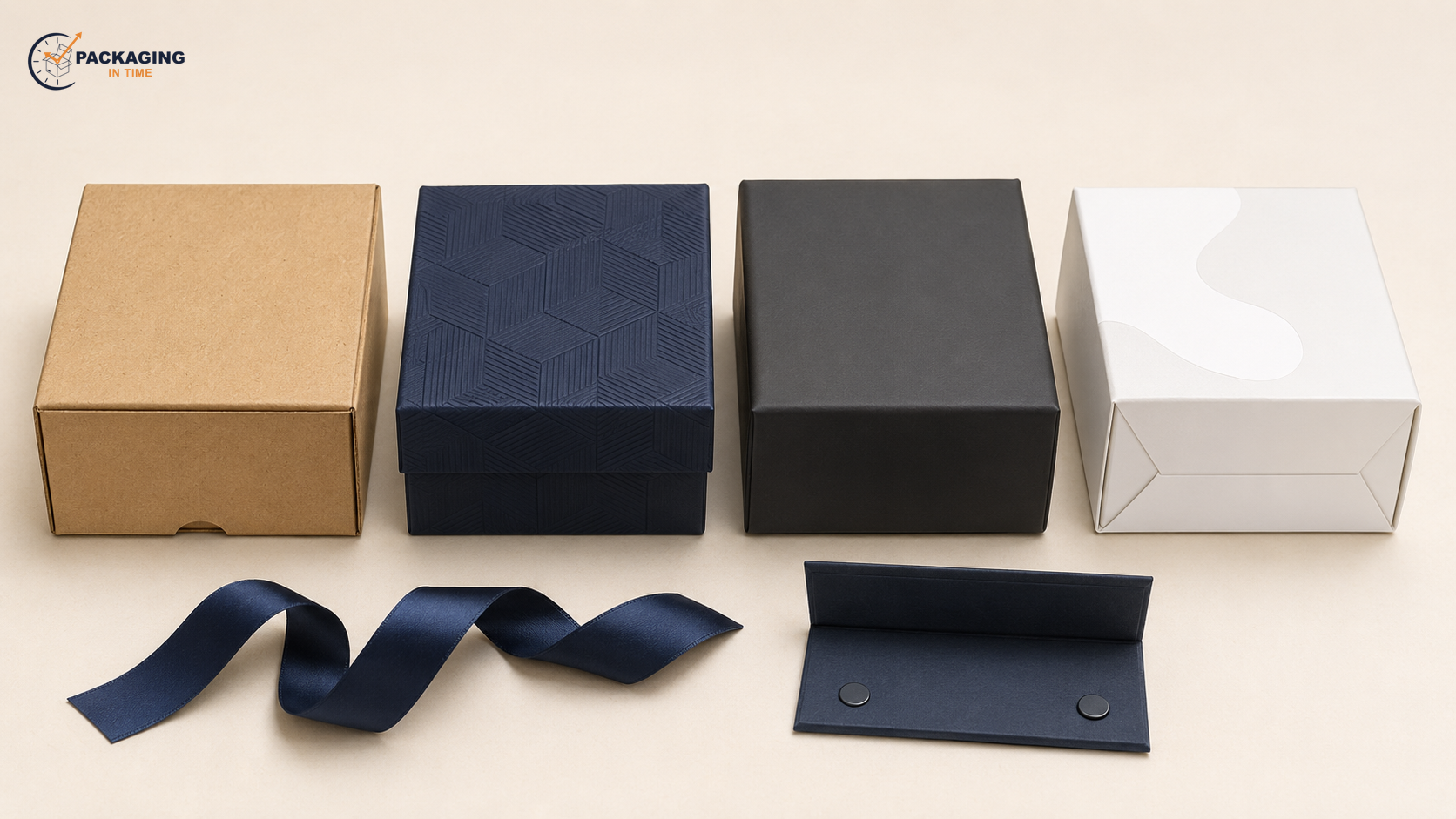
Foil, embossing, debossing, and spot UV can direct attention to a logo area or pattern. Matte, gloss, soft-touch, and anti-scuff finishes affect reflection, texture, and rub behavior. They should be selected by the result the brand needs, not by a default premium checklist.
For example, a dark matte box can make a small embossed mark stand out, but it may show handling marks. A gloss area can add contrast, but it can also make fingerprints more visible. Foil and raised relief need enough area away from scores and edges. Ask for a representative proof or sample when the finish is central to the final presentation.
Can Custom Gift Boxes Support Sustainable Packaging Goals?
Gift packaging often includes components that make simple claims inaccurate. A paperboard box may also have a film laminate, foil decoration, magnets, ribbon, foam, coated tissue, adhesive, or a plastic window. The material claim should identify what is known about the actual finished specification.
Make Specific Material Claims
Use claims that describe a verified attribute. Examples include a specified recycled-fiber content, verified responsible fiber sourcing, or a box designed for reuse. Avoid a broad environmental-benefit claim that does not name and support the specific attribute. The FTC Green Guides state that environmental marketing claims should be truthful and substantiated. EPA guidance also notes that shiny or laminated paper gift wrap may not be recyclable in ordinary paper collection.
If FSC-certified material is part of the requirement, verify the appropriate chain-of-custody and trademark route before using an FSC label in the artwork. The same care applies to recycled-content, compostability, and recyclability claims.
Plan for Reuse and Local Recovery Conditions
Premium gift boxes can be designed for repeat use, such as storage, keepsakes, refills, or organized kits. This can be a practical design goal, but it is different from a recycling claim. Keep components easy to identify where possible. A removable ribbon, insert, or magnet flap may make the final package easier for a customer to sort, but local acceptance rules still decide what is collected and processed.
The most useful approach is specific: list the main material, identify removable components, and give local disposal guidance only after the final material set is known. This is more accurate than placing a generic recycle symbol on every gift box.
How Do Gift Boxes Reach Customers Without Damage?
A polished gift box can leave a fulfillment center looking correct and arrive with crushed corners or surface rub. The retail package needs an outer protection plan that matches the product, route, order configuration, and expected carrier handling.
Protect the Gift Box With a Separate Shipping System
Place the retail gift box inside a corrugated mailer or shipper selected for the packed product. Use the internal system to control movement, then use the outer shipper to protect the customer-facing surface from impacts and stacking. Tissue can improve presentation inside the gift box, while corrugated pads, paper fill, or other selected void-control materials can manage the shipping gap outside it.
Right-sizing matters. An oversized outer box creates more movement and can affect carrier charges because carriers consider both size and weight. A package that is too tight can transfer impact directly to the gift box. Record the final packed outer dimensions and weight, not only the dimensions of the retail box.
Test the Actual Product and Packout
Test the real product in the real box, insert, and outer shipper. Include the heaviest product variation, the actual closing method, normal packing materials, shipping orientation, and intended route. ISTA explains package testing as a way to design and evaluate a package for its distribution environment. A general statement that a box is transit-tested is not useful unless the actual configuration has a valid test record.
Even a simple handling review can reveal problems. Pack the product, close the gift box, ship it in the proposed outer case, carry it, stack it, and inspect the corners, lid, insert, product, and printed surface. Update the structure before production if the test shows movement, scuffing, closure release, or corner damage.
What Common Problems Affect Custom Gift Boxes?
The same failure patterns appear repeatedly. They can usually be traced to a missing measurement, an untested insert, an incomplete artwork handoff, or a retail box being asked to perform like a shipping case.
Loose Product Fit, Lid Friction, and Insert Failure
Loose fit lets a product move and strike the walls. Over-tight fit can scratch the product or slow packing. A lid can bind because a wrapped board, insert, and product height were not reviewed as one system. An insert can buckle because it was designed for a lighter product or because it was not supported by the outer structure.
Use a physical sample to check the full sequence: load the product, close the box, open it, remove the product, repack it, and put it into its shipper. Check that the product is centered, the lid closes consistently, and the insert stays seated after the customer opens the package.
Scuffing, Artwork Errors, and Inconsistent Components
Dark coverage, soft-touch surfaces, and large flat lid panels can reveal scuffs. Decorative components can vary if color, material, placement, or assembly controls are not defined. Artwork errors often come from a missing dieline revision, text placed across a score, barcode changes after approval, or an unreviewed substitute material.
Keep a controlled production file. It should include the approved dieline, artwork version, color specification, finish location, insert drawing, product sample reference, proof approval, and allowed material substitutions. A change should be reviewed when it affects fit, visual appearance, function, food contact, safety, recovery instructions, or shipping performance.
How Do You Order Custom Gift Boxes From Packaging in Time?
The fastest quote process starts with complete inputs. Packaging in Time can help translate them into a production-ready discussion, but the box cannot be accurately specified from a product photo alone.
Prepare Your Product, Artwork, and Quantity Details
Send the product dimensions, packed weight, quantity, and a photo or physical reference. State whether the box is for retail, gifting, a subscription program, or parcel shipment. Include the internal arrangement, insert needs, desired structure, material look, print coverage, color requirements, finish, delivery location, and required date.
State the function of each layer. For example, a candle set may need a rigid lid-and-base gift box, a paperboard or molded insert, tissue for presentation, and a corrugated shipping mailer. A folding apparel box may need tissue, a sleeve, and an outer case. This gives the production team the information needed to identify open questions before a dieline is released.
Approve the Dieline, Proof, and Sample
A digital proof shows how the artwork is expected to appear. It does not prove fit, closure behavior, or packout. A physical sample or pre-production prototype is the better tool for those checks. Review the finished internal dimensions, product clearance, lid action, insert fit, color treatment, finish, and outer-shipping plan before a full run.
Keep final approval controlled. Confirm the final artwork version, board or material choice, finish locations, insert design, quantity, delivery address, and date. If anything changes after approval, review the affected part of the package instead of assuming the original proof still applies.
Request a Custom Gift Box Quote
Packaging in Time offers folding cartons, corrugated mailer boxes, rigid set-up boxes, and specialty packaging. Visit the current product overview to review the broader range, then request a custom quote with your product, style, and delivery details.
A useful gift box balances presentation with a defined structural job. Choose the box based on the product and channel, use an insert where movement needs control, define the finish for real handling conditions, and protect the finished gift box with the right outer shipping system.